01274 532 100


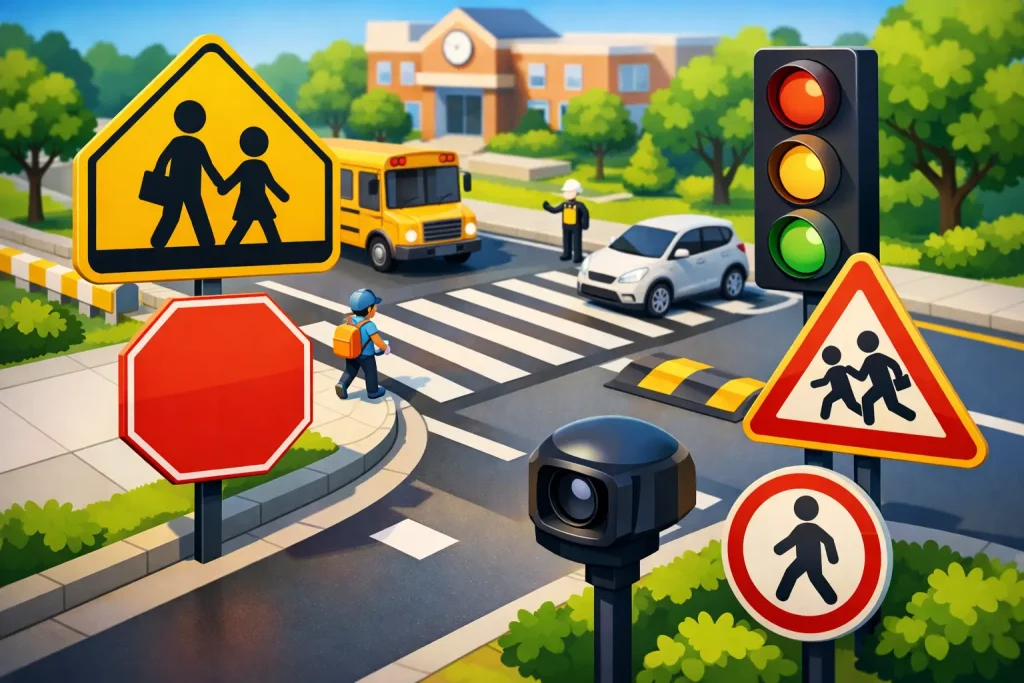
The problem usually starts ten minutes before the bell. Cars stop where they should not, visibility drops, children step out between vehicles, and staff are left trying to manage a traffic situation that signage should already be controlling. Well-chosen school road safety signs are not a cosmetic extra. They are a practical part of keeping pupils, parents, staff and visitors safer at the busiest points of the school day.
For most schools, the challenge is not whether signs are needed. It is choosing the right signs, placing them properly and making sure the message is clear enough to influence behaviour. A school entrance works differently from a retail car park or industrial site. The audience includes hurried parents, unfamiliar visitors, delivery drivers and children who may not judge speed or distance well. That is why school-focused signage needs to be direct, visible and suited to the realities of the education environment.
Why school road safety signs matter so much
At school gates, risk builds from several small issues happening at once. Vehicles queue in short bursts, children arrive on foot, scooters or bikes, and sightlines can disappear quickly if parking is poor. Even where there is no history of serious incidents, near misses often tell the real story. A sign that prevents one unsafe manoeuvre at the wrong moment can make a meaningful difference.
There is also an operational point that schools know well. If road safety around the entrance is poorly managed, staff time gets pulled away from reception, safeguarding checks and morning routines. Site teams end up acting as traffic marshals. Office staff field complaints from neighbours. Families become frustrated because drop-off feels chaotic. Clear signage helps reduce that pressure by setting expectations before a member of staff needs to intervene.
Good signage also supports consistency. Verbal reminders change from one day to the next and depend on who is on duty. Signs stay in place, repeat the message and reinforce the standards the school wants drivers and pedestrians to follow.
What effective school road safety signs need to do
The best signs do not try to say everything at once. They focus on one action, one warning or one rule. For example, “Please drive slowly”, “No parking at any time” or “Protect our children, turn off your engine” each gives a clear instruction. That matters because drivers approaching a school have very little time to process information.
Visibility is equally important. A well-worded sign that is too small, poorly sited or hidden by foliage will not change behaviour. In practice, this means considering approach routes, likely stopping points and the height at which a sign will be seen from a vehicle as well as by pedestrians.
Tone matters too. Schools often need a balance between firmness and approachability. A message aimed at parents should still feel authoritative, but it does not need to sound hostile. In many cases, a polite instruction works better than a confrontational warning, especially when the same families see it every day. That said, there are times when stronger wording is justified, particularly around restricted parking, safeguarding boundaries or vehicle access.
The signs most schools need first
When schools review their site, a few categories almost always come to the front. Parking control signs are often the starting point because poor stopping and waiting create immediate hazards. No parking, keep clear, staff parking only and visitor parking signs help separate traffic movements and stop informal drop-off points becoming normalised.
Speed awareness signs are another priority. Drivers may know they are entering a school area, but visible reminders to slow down are still valuable, particularly where the approach road is wide or where vehicles come in from a faster route. These signs work best before the point of conflict, not after it.
Pedestrian warning signs also play a key role. Where children cross access roads, move between gates and car parks, or walk near delivery areas, signs can reinforce the need for caution. On larger campuses, this is especially important because visitors may not understand the layout and could follow the wrong route.
Engine idling signs are increasingly common for good reason. They address air quality, reinforce considerate behaviour near entrances and support schools that are trying to create a healthier arrival environment. They are not a substitute for wider traffic management, but they are a useful part of it.
Portable signage can also be effective. Pavement signs or temporary roadside signs are useful where schools need to highlight a daily issue at peak times, such as reminding drivers not to block gates or to avoid turning in a particular area. Their strength is flexibility, though they do need bringing in, storing safely and setting out consistently.
Choosing signs for the actual problems on your site
Not every school has the same risk profile. A village primary with one narrow entrance has different needs from a large academy with multiple gates, a coach bay and separate staff parking. The right approach starts with the points where behaviour regularly breaks down.
If parents stop on zig-zags or across driveways, parking restriction signs should be the first focus. If congestion spills into internal access roads, directional signage and wayfinding may be just as important as warning signs. If pedestrians and vehicles mix too closely on site, then crossing points, route markers and entrance control signs become more urgent.
This is where a specialist education signage supplier adds value. Generic road or parking signs may cover the basic instruction, but school environments often need messages that are specific to children, term-time traffic and daily drop-off patterns. A sign designed for a school setting can be clearer in tone, more relevant in wording and more suitable in appearance for parents and visitors.
Placement makes the difference
A common mistake is putting signs only at the problem spot itself. By that point, the driver may already have committed to stopping, turning or queuing. The better approach is to give advance warning and then reinforce it at the decision point.
For example, if parents should not turn right into a gate at busy times, the first sign should appear before the turn, with a second sign at the entrance. If visitor parking is frequently misused, signs should be visible on approach, at the bay itself and, where needed, at pedestrian routes leading to reception.
Height, angle and clutter all matter. A sign surrounded by other notices can be lost. A low sign may be hidden by parked vehicles. A message aimed at drivers needs to sit within their line of sight, while signs for pedestrians should be readable without causing them to stop in an unsafe place.
Schools should also think seasonally. Dark winter mornings, wet weather and foliage growth can all reduce effectiveness. A sign that works in September may be harder to see by January or June depending on conditions around the site.
Durability, maintenance and appearance
Schools need signs that can cope with daily use, changing weather and occasional knocks from bags, bikes or vehicles. Durability is not only about appearance, though presentation matters on the main approach to the school. A faded or damaged safety sign can be ignored because it signals that the rule is not being actively managed.
Materials, print quality and fixings all affect lifespan. External signs need to stay legible and secure over time. Portable signs need to be stable enough for repeated use without becoming awkward for staff to handle. It is worth choosing products suited to school operations rather than the cheapest available option, especially for high-traffic areas.
There is also a reputational point here. Entrance signage contributes to first impressions. Schools want to look well run, welcoming and safety conscious. The strongest sites manage to combine those things. Clear road safety signage does not need to feel harsh or industrial to be effective.
When standard signs are enough, and when custom works better
Off-the-shelf signs are often the quickest answer for common issues such as no parking, keep clear or please drive slowly. They are cost-effective, easy to order and suitable for many schools.
Custom signage becomes more useful where the message needs to reflect a particular entrance layout, trust branding, safeguarding instruction or local traffic problem. A site with a split entrance for nursery and main school, for example, may benefit from tailored directional and safety messages rather than a collection of standard signs that only partly fit the situation.
It depends on the site and the level of recurring non-compliance. If a standard sign has been in place for months and behaviour has not improved, the issue may be wording, visibility or placement. It may also be that a more site-specific sign is needed to remove ambiguity.
A practical way to review your signage
Schools do not always need a full site overhaul. Often, the better starting point is a short review during drop-off and pick-up. Watch where vehicles hesitate, where pedestrians bunch together and where rules are being ignored. Those points will usually tell you which signs are missing, unclear or badly positioned.
It also helps to ask who the sign is for. Parents, contractors, taxi drivers, visitors and sixth form students may all use the site differently. One sign rarely speaks equally well to all of them. A more effective system uses a small number of targeted messages in the right places.
Signs 2 Schools works with education settings because these details matter. Schools need products that are easy to buy, fit for purpose and designed around the way school sites actually operate.
When school road safety signs are chosen with care, they do more than fill a wall or gate. They reduce confusion, support staff, improve traffic behaviour and help protect children where it matters most – at the point where the school meets the road. If your entrance still relies too heavily on staff reminders and goodwill, that is usually a sign the signage needs attention first.