01274 532 100


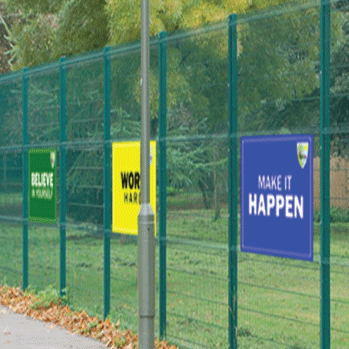
A school’s values should not be confined to a prospectus, website or staff meeting presentation. They need to be visible where pupils make choices, resolve disagreements, welcome visitors and begin each new day. Well-designed primary school values banners put the language of your school ethos at eye level, turning words such as respect, resilience and kindness into a familiar part of the environment.
For busy primary schools, this is not simply a decoration project. Values displays can support behaviour expectations, reinforce assemblies and PSHE work, and help every adult on site use the same positive language with children. The most effective banners are clear, durable and placed with purpose.
Why primary school values banners work
Children respond well to consistent visual prompts. A value displayed in the hall and repeated in classrooms, corridors and shared spaces becomes easier to recognise and recall. When a pupil hears, “That showed real perseverance,” they can connect the praise to a word and image they have seen many times before.
Values banners also help visitors understand the character of a school quickly. Parents arriving for an open morning, governors attending a meeting and prospective families visiting reception should be able to see what matters to the school without needing an explanation. A welcoming display creates a stronger first impression than a list of policies behind the office desk.
There is a practical benefit for staff too. A consistent set of values gives teaching staff, lunchtime supervisors, office teams and volunteers a shared reference point. This is particularly useful in larger schools, federations and academies where children encounter many different adults during the week.
That said, banners do not create a values-led culture by themselves. If the wording on the wall is never used in assemblies, classroom conversations or behaviour recognition, pupils will quickly treat it as background. The display works best when it supports routines that already matter to the school.
Choosing values that pupils can understand
The strongest displays do not try to say everything at once. Six to eight core values are usually easier for primary-aged children to remember than a long statement containing every aspiration the school has identified. The right number depends on your existing ethos, but clarity should lead the decision.
Words need to be age-appropriate without becoming simplistic. Kindness, honesty, respect, courage, responsibility and curiosity are familiar and useful across the primary age range. More abstract terms, such as integrity or aspiration, can work well where they are already embedded in school language, but may need a short explanation or supporting phrase for younger pupils.
A single word can be powerful, especially when staff regularly discuss what it looks like in practice. For example, resilience may be accompanied by “keep trying when work feels difficult”, while respect might be linked to “listen, care and use kind words”. These short prompts make the value actionable rather than merely decorative.
Keep language consistent across the site
Check the wording against your behaviour policy, rewards scheme, school improvement plan and classroom resources before approving a design. If pupils receive certificates for demonstrating “determination” but the corridor banner says “perseverance”, both terms may be valid, yet the difference can dilute the message.
Consistency matters even more where schools use a trust-wide framework alongside their own local identity. In this situation, a banner scheme can acknowledge shared values while retaining the school name, colours and illustrations that make the setting feel recognisable to its community.
Design for the way children see and use the space
Primary school displays need to appeal to children without looking cluttered or temporary. Large type, high-contrast colours and simple illustrations are more effective than dense text or small decorative details. Pupils should be able to identify each value while walking through the hall, not only when standing directly in front of it.
Colour can help children distinguish values, particularly where each class, house group or award certificate uses the same palette. However, colour choices should still work with the school’s branding and be readable in different light conditions. A pale yellow word on a white background may look attractive on screen but will not perform well in a bright corridor.
Consider the age of the pupils who will use the area. Early years and Key Stage 1 children may engage with friendly characters, clear symbols and short phrases. Older primary pupils often respond better to a more grown-up visual style, perhaps with bold patterns, photography or illustrated scenes that show cooperation, learning and community action. A whole-school display can balance both by using clean graphics rather than relying on overly young imagery.
Material choice is equally important. Indoor banners should withstand daily contact, cleaning and the occasional energetic pupil passing through a busy corridor. For entrance areas, halls and external walls, weather resistance, secure fixings and a finish suited to the mounting surface should be considered before ordering. A banner that curls at the corners or fades after one term does not reflect the standards the school wants to communicate.
Put banners where they can reinforce daily routines
The school entrance is a natural place for a values display because it sets the tone for pupils, families and visitors. A reception wall, gate area or covered entrance can present the school’s values alongside its name and welcome message. This is especially effective for open evenings, admissions visits and transition events.
The hall is another high-value location. Assemblies provide the ideal opportunity to introduce a value, celebrate examples and refer directly to the display. Positioning banners where pupils sit or line up means the message is regularly seen without taking up essential teaching wall space.
Corridors, dining areas and playground-facing spaces can extend the message, but avoid putting the same full design on every wall. Repetition is useful; visual overload is not. A main banner set in the hall, supported by smaller value-specific signs near relevant spaces, often works better. For instance, a kindness message may suit the dining hall, while resilience can sit near a learning hub or library.
If banners are installed outdoors, assess sightlines before finalising dimensions. A message intended for parents at the gate needs to be readable from a distance and positioned where parked vehicles, fencing or trees will not obscure it. Outdoor displays should also complement essential safeguarding, visitor and traffic-management signage rather than compete with it.
Make the display part of school life
The difference between an attractive banner and a useful one is what happens after installation. Introduce the values in an assembly and explain what each one means in everyday school life. Give pupils examples they can recognise: inviting someone into a game, admitting a mistake, trying a difficult calculation again or helping to tidy a shared area.
Staff can then use the same vocabulary in praise, restorative conversations and home communication. A child who receives a note home for showing responsibility will make a stronger connection if the word is prominent around school. Values can also shape pupil leadership roles, reading choices, themed weeks and displays of children’s work.
It is worth involving pupils in the process, even when the final banners are professionally produced. School councils can discuss which illustrations feel representative, write short child-friendly explanations or suggest examples of values in action. This improves ownership and can reveal whether the chosen language genuinely makes sense to the people it is intended to support.
Plan the project before ordering
Measure each location carefully and note the wall surface, available fixing points and viewing distance. A narrow corridor may need portrait banners, while a large hall wall may suit a landscape set or a series of individual panels. Take account of fire safety requirements and avoid covering existing statutory notices, alarm points or evacuation information.
Before signing off artwork, check names, logos, spelling and punctuation with more than one member of staff. Values signage tends to remain in place for years, so a careful proofing process prevents costly amendments. It is also sensible to consider whether the design can be updated if the school refreshes its logo or joins a new trust.
A specialist education signage supplier can help match the banner format, material and design approach to the realities of a school site. Signs 2 Schools supports schools with child-friendly, hard-wearing displays that sit comfortably alongside their wider safety, wayfinding and welcome signage.
The best values banners do not demand attention through complicated wording or crowded graphics. They give pupils a clear reminder of how their school community chooses to treat one another, then allow staff to bring those words to life every day.