01274 532 100


The school gate can become the busiest and most difficult part of the site in less than ten minutes. Cars stop where they should not, pupils cross between vehicles, visitors look for reception, and staff are trying to keep the entrance calm and secure. When asking what signs do schools need, the most useful answer is not simply ‘more signs’. It is the right signs, in the right places, with messages people can understand at a glance.
For schools, colleges and nurseries, signage has a practical job to do. It must help protect pupils, support safeguarding procedures, reduce avoidable disruption and make the site feel welcoming to families and visitors. A clear sign system also saves staff time: fewer directions given at reception, fewer parking conversations at the gate and less uncertainty during busy periods.
Start with the journeys people make
A school site is used differently by pupils, parents, staff, contractors, visitors and emergency services. Each group needs clear information at different points. Before choosing individual products, walk the site at arrival, collection and visitor times. Look for the moments where somebody has to stop, guess or ask for help.
The priority is usually the journey from the public road to the main entrance. Is it obvious where vehicles may and may not stop? Can a first-time visitor find reception without walking around the site? Are pedestrian routes clearly separated from traffic? Does the entrance communicate the school name, safeguarding expectations and visitor process?
This approach avoids a common problem: buying a collection of signs that look good individually but do not work together as a site-wide system. A primary school with a busy roadside entrance may need a strong parking and road-safety focus. A large secondary school or college may need more detailed directional and department signage. A nursery may place greater emphasis on a friendly arrival experience, secure access and child-focused safety reminders.
What signs do schools need for safety?
Safety signage should focus on the risks people encounter every day, not on covering every available surface. Messages must be visible before a driver, pedestrian or visitor reaches the decision point. A ‘No Parking’ sign placed beyond the point where cars usually pull in will have far less effect than one positioned on the approach.
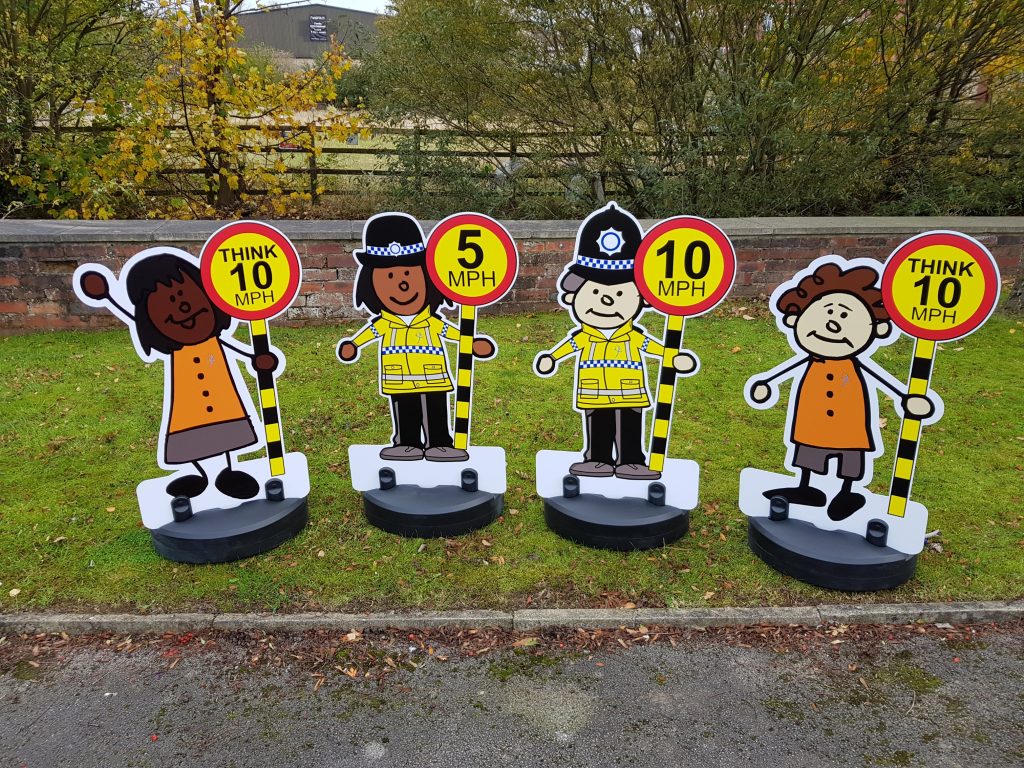
School-gate parking signs are often among the highest-value additions to a site. Clear messages such as ‘Keep Clear’, ‘No Stopping’, ‘Staff Parking Only’ and ‘Protect Our Children, Turn Off Your Engine’ help address unsafe stopping, blocked access and engine idling. Pavement buddies can be particularly effective at drop-off and collection because they place the message directly in a driver’s line of sight, while remaining easy for staff to position and store.
Where traffic and pedestrians share space, use signs to establish the route rather than merely warn about the hazard. Directional arrows, pedestrian crossing reminders, speed-limit messages and designated pick-up point signs can reduce confusion. On larger sites, vehicle entrance and exit signs help maintain flow and prevent drivers from turning around in unsuitable areas.
The exact mix depends on the layout. A sign cannot solve a poorly designed access route on its own, and it should support, rather than replace, physical measures such as marked bays, gates, barriers or supervised crossing points. However, consistent, well-positioned signage makes those measures easier for people to follow.
Main entrance, safeguarding and visitor signs
The main entrance is where safety, safeguarding and school identity meet. Visitors should know immediately where to report, whether they need to sign in, and which areas are restricted. This is not about making a school feel unwelcoming. It is about giving clear instructions so legitimate visitors can act confidently while staff retain control of access.
A well-planned entrance typically includes the school name, a reception or visitor entrance marker, visitor sign-in instructions and appropriate safeguarding notices. Depending on the school’s policy, this may include reminders about identification badges, mobile phone use, photography and DBS-related requirements for contractors or volunteers.
Security signs need careful wording. Overly aggressive messages can create an unhelpful first impression, while vague wording may be ignored. Straightforward notices such as ‘All Visitors Must Report to Reception’ or ‘CCTV in Operation’ are clear, professional and appropriate for most education settings. If your school uses electronic access control, a simple instruction near the call point can prevent visitors from following others through a secured door.
For safeguarding messaging, keep the audience in mind. Information intended for staff and regular volunteers may need to be located inside the site, while public-facing signs should only communicate what visitors need to know. The school’s safeguarding lead and site manager should agree content before it is produced.
Wayfinding that reduces pressure on reception
Wayfinding is often underestimated until a parent, supply teacher or contractor arrives late because they could not find the correct entrance. Directional signs should work as a sequence: at the site entrance, at the first junction, and again where the destination becomes visible.
Use familiar destination names rather than internal shorthand. ‘Reception’, ‘Sixth Form Entrance’, ‘Sports Hall’, ‘Visitor Parking’ and ‘Deliveries’ are clearer than acronyms or room codes. If the site has separate entrances for early years, junior, senior or community facilities, identify them consistently on signs, maps and communications.
Wall-mounted directional signs suit corridors and building approaches, while post-mounted signs, fingerposts and monolith totem signs are useful outdoors. A custom monolith sign at the entrance can combine school branding with practical information, helping visitors recognise the correct location before they enter. For multi-building sites, a simple orientation map may be worthwhile, but only if it is accurate, easy to read and kept current.
Colour can support wayfinding, especially where distinct buildings or zones are involved. It should not be the only cue, though. Clear words, arrows and high-contrast design are still essential for accessibility and for visitors who are unfamiliar with the site.
Signs for classrooms, corridors and shared spaces
Internal signs help schools maintain routines without requiring repeated verbal reminders. The best examples are specific to their location: wet-floor and fire-door notices near the relevant risk, quiet-area signs where concentration is needed, and clear room identification at every teaching space.
Health and safety signs may cover first aid points, fire action, emergency exits, hazardous substances, plant rooms, kitchen areas and authorised-person-only spaces. These are operational signs, so durability and legibility matter more than decoration. Check that required safety signs remain visible after displays, furniture or seasonal materials are added.
Exam signage is another practical requirement. During assessment periods, signs requesting silence, directing candidates and restricting access can prevent unnecessary disturbance. Reusable exam signs allow the school to prepare quickly each year, while temporary banners or pavement signs can alert people before they reach the exam area.
Noticeboards and display systems have a different purpose. They give schools a controlled place to share dates, achievements, parent information and community messages. Without them, temporary notices tend to spread across doors, windows and reception areas, making important information harder to spot. Choose lockable external noticeboards where content needs protection from weather or unauthorised changes.
Use welcoming signage as part of the school environment
A safe school should not look like a fortress. Entrance signs, banners, wall graphics and values displays can make the environment feel positive while supporting a clear sense of identity. This matters particularly for open evenings, prospective families, community users and pupils arriving at the start of the day.
For younger pupils, child-friendly graphics can reinforce behaviours such as walking, washing hands or keeping gates closed. For older students, well-designed displays can communicate values, careers information, attendance expectations or wellbeing support in a more respectful, age-appropriate way.
The trade-off is visibility. Too many posters, colours and messages competing for attention can make a space less effective, not more. Reserve prominent positions for essential instructions, and use branded or motivational graphics to improve otherwise blank walls and corridors.
Choosing materials, sizes and installation locations
A sign is only useful if it withstands its environment. External signs need materials suited to rain, UV exposure and regular cleaning. Signs near roads or car parks may also require more substantial mounting and a size that can be read from a vehicle. Indoor classroom signs can often be lighter, but still need secure fixing and a finish that is easy to wipe clean.
Consider viewing distance before ordering. Small text can work at a doorway where a person is standing close by; it will not work at the end of a drive or across a playground. Similarly, pavement signs need a stable base and a message short enough to read while walking or driving past.
Site teams should also plan who will update temporary information. Changeable letter boards, poster cases and reusable banners can be more practical than printing a new sign for every event. Permanent signs should be reviewed periodically, especially after building works, changes to access arrangements or a rebrand.
Build a sign plan that staff can maintain
The most effective schools treat signage as part of premises management, not as a one-off purchase. Create a simple list of existing signs, their purpose, location and condition. Identify faded, contradictory or obsolete messages first, then address the routes and risks that affect the greatest number of people.
Signs 2 Schools can help education settings turn those practical issues into school-specific products, from parking control and safeguarding notices to branded entrance signage. Whether you need ready-to-order safety signs or a tailored solution, the aim should remain the same: make the expected action obvious.
Walk from the kerb to reception as a new parent or visitor would. Every place where they hesitate is an opportunity for a clearer sign, a safer route and a calmer school day.