01274 532 100


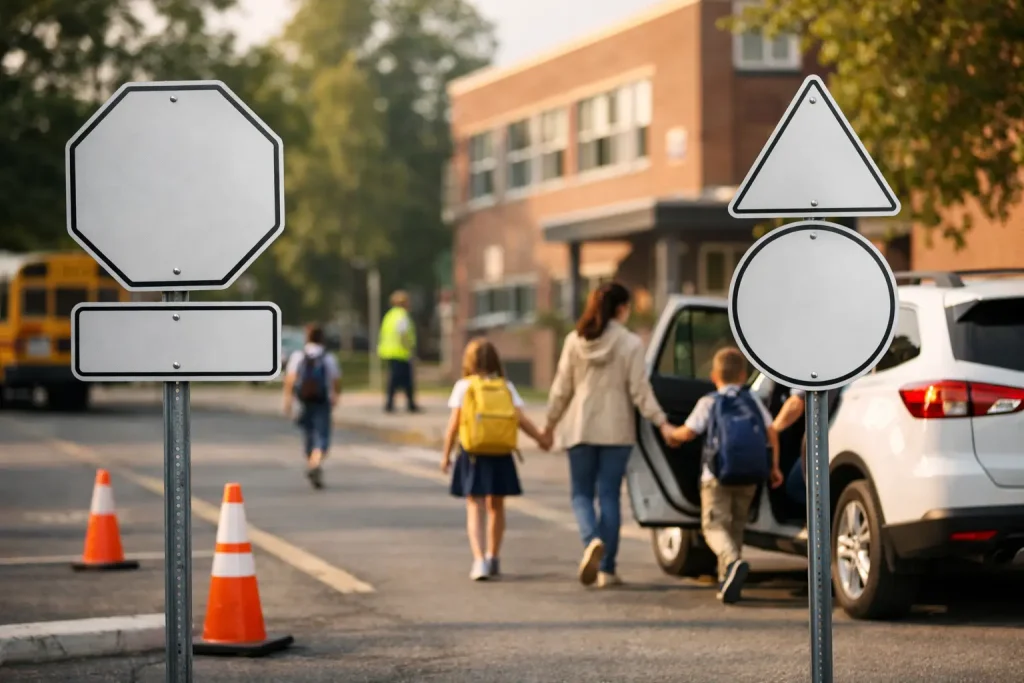
The busiest ten minutes of the school day can create the greatest risk. Cars stopping on zig-zags, parents turning in tight spaces and visitors unsure where to park all place pressure on the entrance just as pupils are arriving or leaving. Well-positioned school parking signs give clear instructions before a driver reaches the gate, helping schools protect children and keep traffic moving.
For most schools, the issue is not simply a lack of parking spaces. It is unclear behaviour at key points across the site: the roadside, pedestrian crossings, the staff car park, visitor bays and the entrance itself. The right signs turn those problem areas into clear, consistent routes for drivers and pedestrians.
Start with the parking problems on your site
A useful parking sign scheme starts with observation, not a catalogue. Ask staff to watch the site at drop-off and collection for several days, including wet-weather days and events. The patterns are often predictable: a vehicle blocks the gate for two minutes, another follows, and suddenly a child has to walk between cars to reach the pavement.
Look at where vehicles stop, reverse or turn around. Consider sightlines from the road, whether pedestrians have a protected route, and whether the existing message is visible from a moving vehicle. A faded sign placed after the decision point will rarely change behaviour, however strongly it is worded.
It also helps to separate the issues that occur on the public highway from those within the school boundary. Restrictions such as yellow zig-zag markings and controlled parking zones are managed by the relevant highway authority. School signs can reinforce the safety message, but they do not replace official traffic controls or make a school-created restriction legally enforceable on a public road. Where a recurring problem affects the highway, work with the local authority alongside improving the signs on and around your own site.
Choose school parking signs for each decision point
Drivers need a message at the moment they can act on it. That usually means using a small number of signs in connected locations rather than relying on one large notice at the gate.
Before vehicles reach the entrance
Advance signs are particularly useful where parents approach from a busy road or where there is no safe place to stop outside the gate. Messages such as “Keep Clear”, “No Stopping at School Entrance” and “Do Not Park on Zig-Zags” should be short enough to read at a glance. A child-focused message can be more persuasive than a rule alone: “Protect Our Children, Turn Off Your Engine” connects a driver’s choice directly to the school community.
If congestion is causing idling, anti-idling signs give staff a consistent prompt to use at the gate. They work best where the school has also explained its approach through parent communications, rather than appearing as an unexpected instruction on collection day.
At the entrance and pedestrian crossing points
The gate is where messages need to be direct. Use clear signs to keep access routes free, identify pedestrian entrances and prevent vehicles from blocking emergency access. Signs should not compete with one another. If every surface carries a different instruction, drivers may miss the one that matters most.
Pavement buddy signs can add visibility at temporary pinch points, especially when positioned by staff at drop-off and collection. Their friendly, child-focused format can be effective for reminders about parking considerately, driving slowly and keeping the crossing clear. As portable products, they need to be brought in after use and should never obstruct the pavement, visibility splays or an accessible route.
Inside the school grounds
Once a vehicle enters the site, the priority changes from deterring roadside stopping to organising access safely. Directional parking signs help visitors find reception, designated parking and delivery areas without driving across pedestrian routes. Clearly marked staff, visitor, disabled and reserved bays reduce uncertainty and avoid uncomfortable conversations at reception.
Where space is limited, a simple one-way system may be more effective than attempting to accommodate every vehicle. Entry, exit, stop, give way and speed reminder signs should be placed consistently along the route. A low site speed message is particularly valuable near playground gates, nursery entrances and areas where children may step out unexpectedly.
For a larger campus, consider whether a freestanding sign, wall-mounted panel or custom monolith totem sign is the most appropriate format. A totem at the entrance can combine a welcome message, visitor direction and parking information in one durable focal point. Smaller signs then confirm the route once drivers are inside.
Make messages clear, respectful and difficult to miss
A sign cannot solve a parking problem if drivers cannot see or understand it. Use high-contrast colours, legible lettering and a message that can be read quickly. Positioning matters just as much as design: place signs at driver eye level where possible, before the point where a car needs to turn, stop or give way.
Tone matters too. Schools need to protect pupils without creating unnecessary friction with families. “Please keep this entrance clear for children” can be more constructive than a long block of prohibitive text, while still setting a firm expectation. In areas where repeated unsafe parking is a concern, clearer wording is appropriate: “No Parking – Keep Emergency Access Clear” leaves little room for misunderstanding.
Avoid trying to include every rule on one board. A large entrance sign can explain the overall arrangement, but individual actions need individual prompts. For example, use one sign for visitor parking, another for deliveries, and a separate sign for safeguarding instructions at reception. This approach is easier for drivers to follow and easier for the school to update when site arrangements change.
Consider materials, mounting and maintenance
External school parking signs need to cope with rain, wind, cleaning and daily use. Rigid weather-resistant boards are suitable for permanent fixing to walls, gates, railings or posts. Reflective finishes can improve visibility where signs are read in poor light, although the best choice depends on the location, lighting and message.
Fixings deserve attention. A well-designed sign can be ineffective if it twists in the wind, is hidden behind foliage or is mounted where an opening gate covers it. Before ordering, check available mounting surfaces, take measurements and confirm whether a post, rail fixing, wall fixing or freestanding option is required.
Review signs regularly, particularly after changes to gates, fencing, parking layouts or building works. Remove outdated notices promptly. A collection of obsolete temporary signs gives the impression that instructions are optional and makes current safety messages harder to find.
Support signs with a workable traffic plan
Signs are most effective when they support an arrangement parents and visitors can realistically follow. If there is no alternative waiting area, no clear visitor route or no way to know where to collect a child, even the best signage will be tested at peak times.
Set out expectations in joining information, newsletters and event invitations. Explain where families should park, which gates they should use and why certain areas must remain clear. For special events, temporary directional signs and staff marshals can prevent the usual arrival plan from being overwhelmed.
It is also worth involving the people who see the problem first. Site staff, crossing patrols, reception teams and parent representatives can identify confusing instructions or recurring pinch points that are not obvious from an office window. Their feedback may show that a sign needs moving ten metres, not replacing entirely.
Signs 2 Schools supplies school-focused parking, road safety and directional signage designed to make these messages clear, durable and appropriate for education settings. Standard messages are useful for common concerns, while custom signs allow schools to reflect their own entrance layout, wording and visual identity.
A safer school gate is built from many small, visible decisions: where cars wait, where children cross and how clearly everyone understands the route. Start with the point of greatest pressure, give drivers one practical instruction they can act on, and build from there.