01274 532 100


The best parking signs for schools do more than tell drivers where not to stop. They make the busy period before registration and after the final bell safer, calmer and easier for everyone to manage. A clear sign in the right location can prevent a blocked gate, keep emergency access open and give parents a fair reminder before a member of staff has to step into the road.
For school business managers, site teams and headteachers, the right solution depends on the layout of the site and the behaviour causing concern. A small primary school with a congested gate needs a different approach from a large academy with separate staff, visitor and delivery entrances. The most effective signs use short, direct wording, are visible from a moving vehicle and support the traffic arrangements already in place.
Start with the problem at the school gate
Before choosing a sign, identify what is happening and where. Spend a few drop-off and collection periods observing the route from the road to the entrance. Look for vehicles stopping on zig-zag markings, cars idling outside classrooms, blocked driveways, parents using staff bays and pedestrians crossing between parked vehicles.
This matters because a general message such as “No Parking” may not solve a specific issue. If drivers are stopping in a fire access route, the sign should say so. If the concern is engine idling near pupils, a dedicated anti-idling message is more useful. Where families are unsure which gate to use, wayfinding signs may reduce unnecessary vehicles circulating around the site.
A short site review also helps schools avoid putting signs where they will be missed. Drivers need to see the instruction before they commit to turning into an entrance, parking bay or narrow access road. A sign hidden behind a hedge or placed beside the problem rather than before it is unlikely to change behaviour.
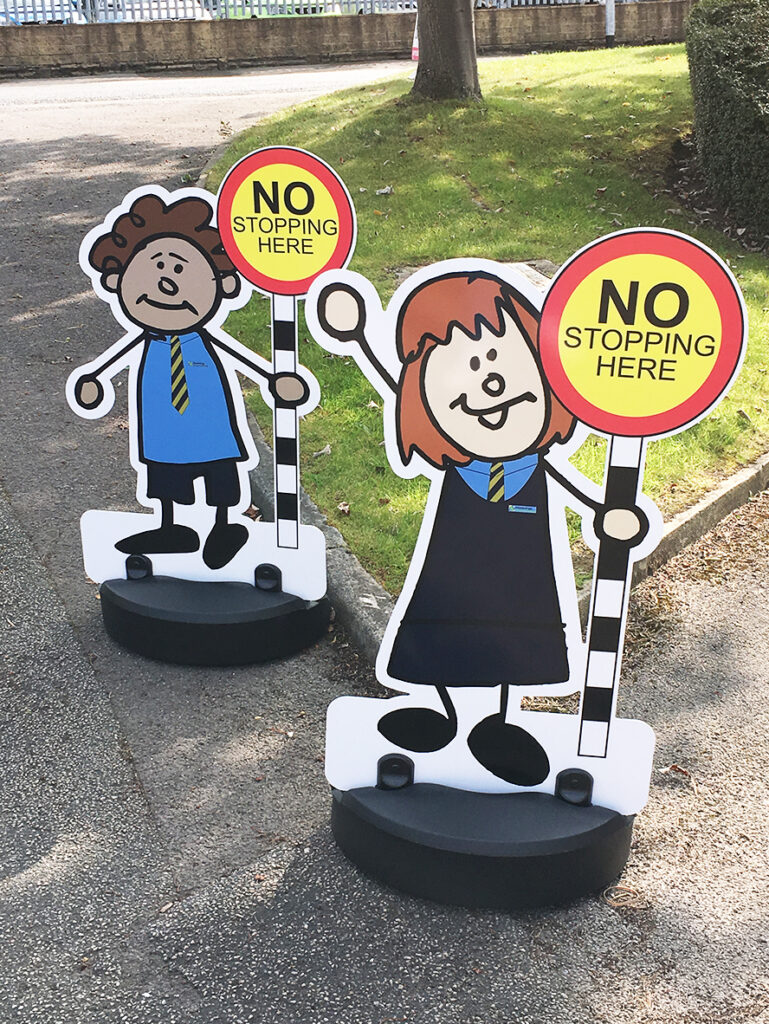
Kiddie Cut Out Road Safety Parking Buddies Pavement Sign with Lollipop Message
Best parking signs for schools by use case
Keep Clear and no parking signs
Keep Clear signs are a practical first choice for gates, turning circles, pedestrian crossings and emergency access points. They work best when the wording identifies the reason for the restriction, such as “Keep Clear – Emergency Access” or “Keep Clear – School Entrance”. The reason gives drivers context and makes the request harder to dismiss as a general rule.
For car parks, a clear “No Parking” or “No Stopping” sign can protect areas that must remain open. These include delivery zones, refuse collection points, bus turning areas and access routes for emergency services. Use plain wording and a recognisable symbol where appropriate. Parents collecting children have little time to read a long notice from behind the wheel.
It is worth distinguishing between stopping and parking. A driver may argue that they have only stopped for a moment, which is precisely the problem at a busy gate. Where brief stopping creates risk, “No Stopping” is the clearer instruction.
Staff, visitor and disabled parking signs
Clearly marked parking bays reduce friction at the start of the school day. Staff parking signs help protect spaces for employees who need to arrive before pupils, while visitor parking signs give guests an obvious place to report and park. This supports safeguarding too, particularly when visitor spaces are positioned near the main reception route rather than near a pupil entrance.
Disabled parking signs should be highly visible and paired with correctly marked bays. Avoid assuming that one sign at the car park entrance is enough. A driver needs confirmation at the bay itself, especially when the site is unfamiliar or spaces are limited.
Where car parking is managed by permits, the sign should explain the condition simply: “Permit Holders Only” or “Staff Permit Holders Only”. Adding a long list of exceptions tends to create uncertainty. Put detailed parking arrangements in visitor information or staff communications, while the sign handles the immediate instruction.
Parent drop-off and pick-up signs
A designated drop-off area can improve traffic flow, but only if parents understand how it operates. Signs should state whether drivers may stop, how long they may wait and whether the vehicle must remain attended. If the arrangement is one-way, add directional arrows before the point of decision and repeat them at junctions.
For many schools, a polite but firm message is especially effective. Phrases such as “Protect Our Children – Please Do Not Park at the School Gate” connect the instruction to pupil safety. They are more persuasive than a vague warning, particularly where enforcement powers are limited.
Pavement buddy signs are useful during peak periods because they sit at driver eye level and can be positioned where the issue occurs. They are not a substitute for permanent signs at fixed hazards, but they work well for reinforcing a seasonal campaign, a temporary route change or a recurring problem outside a gate.
Anti-idling signs
Engine idling is often treated as a minor annoyance, yet it affects air quality around children and can cause complaints from neighbours. Anti-idling signs give schools a straightforward way to set expectations. A direct message, such as “Protect Our Children, Turn Off Your Engine”, is easy to understand and fits the school environment.
Place these signs where parents queue or wait, rather than only at the entrance. If the queue regularly extends along a residential road, communication may also need to go beyond the school boundary through newsletters and travel-plan messaging. Signage works best when it is backed by staff consistency and clear alternatives, such as a designated waiting area or walking route.
Directional and wayfinding signs
Not every parking issue is caused by poor behaviour. Sometimes drivers simply cannot tell where to go. Directional signs for reception, visitor parking, staff parking, deliveries and exit routes reduce last-minute turns and vehicles reversing in unsuitable places.
Use arrows consistently throughout the site. If blue is used for visitor parking, keep that colour and wording the same at every decision point. A family or visitor should not have to interpret several different messages while watching for pupils crossing the road.
Choose materials that suit the location
External parking signs need to cope with rain, sunlight, frost and regular cleaning. Rigid aluminium composite signs are a dependable option for permanent mounting on walls, fences and posts. They provide a professional finish and retain clear print in exposed locations.
For a sign that must be noticed from a distance, size matters as much as material. Small signs may be suitable at a parking bay or beside a pedestrian gate, but entrance signs and roadside messages must be large enough to read from a vehicle. Reflective finishes can help where drivers arrive or leave during darker winter afternoons.
Consider how the sign will be fixed before ordering. A wall-mounted sign, post-mounted sign and movable pavement sign each solve different problems. Post-mounted signs offer visibility where there is no suitable wall, while pavement signs can be brought in at the end of the day. Movable products need a secure storage routine and should never obstruct accessible routes or create a trip hazard.
Make wording firm, fair and enforceable
Schools often want a sign that says parking is prohibited, but the wording should match the authority the school has over the land. On a private site, signs can set out school rules and conditions of use. They do not automatically create the same enforceable restrictions as highway markings or a restriction introduced by the relevant highway authority.
This is particularly relevant near school gates on public roads. Yellow lines, zig-zags and formal parking restrictions are matters for the local authority and should not be copied or represented as official controls. If unsafe parking is occurring on the highway, record dates, times and photographs where appropriate, then raise the issue through the local authority, parking enforcement team or road safety contact.
Within school grounds, avoid threats that cannot be acted upon. “No Parking – Keep Access Clear” is often more credible than a warning about penalties where no enforcement process exists. If the school does operate permits, barriers or contractual parking controls, make sure the wording has been agreed with the relevant estates, legal or trust team.
Position signs as part of a wider traffic plan
Even the clearest sign will struggle if the site layout sends mixed messages. Pair parking control signs with visible pedestrian routes, entrance markers, speed reminders and clear collection arrangements. Staff on gate duty should use the same language as the signs, so parents receive one consistent message.
Review the signs after a few weeks. If vehicles still stop in the same spot, the issue may be visibility, wording or the lack of a practical alternative. A slightly earlier sign, a larger format or a second reminder at the exit can make a measurable difference.
Signs 2 Schools can help schools match parking, safety and wayfinding signs to the realities of their site, from standard parking control messages to tailored designs carrying school colours and instructions. The aim is not to fill the grounds with notices. It is to give every driver a clear instruction at the moment it is needed, leaving pupils with safer space to arrive, depart and learn.