 01274 532 100



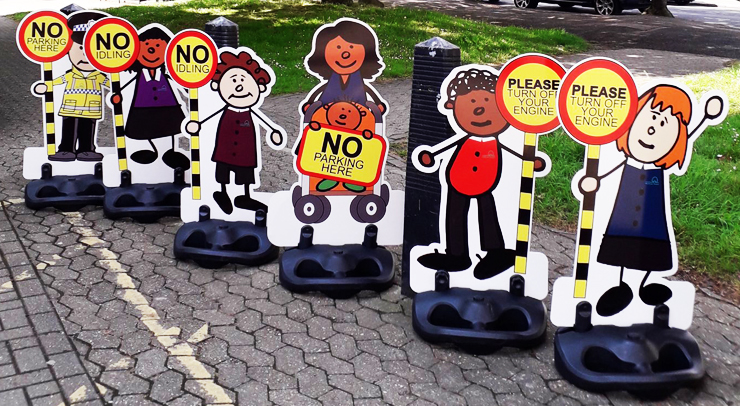
The busiest ten minutes of the school day can create the greatest risk. Cars stop on zig-zags, parents turn in unsuitable spaces, pedestrians step between vehicles and staff are left trying to manage traffic while welcoming pupils. This school parking signage success example shows how a planned, visible set of signs can help turn a difficult drop-off point into a safer, more orderly entrance.
The key is not simply putting up a ‘No Parking’ sign. Parents and visitors need clear instructions before they reach the gate, reminders at the point of decision and a layout that makes the expected behaviour easy to understand. Signage cannot solve every parking issue on its own, but it gives staff a consistent, professional way to communicate the rules.
The problem: unsafe stopping at the school gate
A primary school had a familiar morning issue. The main entrance sat on a narrow residential road, with a small staff car park beside it. Although the school had previously sent parking reminders home, several vehicles regularly stopped across the entrance, near the crossing point and in front of neighbouring driveways.
The impact went beyond inconvenience. Pupils arriving on foot had a reduced view of approaching traffic. Parents using the car park could not always leave safely, and office staff were repeatedly drawn outside to ask drivers to move. The school needed a solution that was firm but child-focused, and one that did not rely on a member of staff being stationed at the gate every morning.
Before ordering signs, the site team observed the entrance over five school days. They recorded where vehicles stopped, which routes pedestrians used and where drivers appeared uncertain. This short review identified an important point: some drivers were knowingly stopping where they should not, but others simply did not understand where the visitor entrance, staff parking and pedestrian route began.
School parking signage success example: a clear sign plan
The school introduced a sign plan based on each decision a driver needed to make. Rather than repeating the same message in several places, the signs worked together from the road to the entrance.
At the approach to the gate, a large school safety sign reminded drivers to slow down and watch for children. Near the entrance, a clear parking control sign stated that the access must be kept clear at all times. The wording was direct and supported by a recognisable symbol, so it could be understood quickly from a vehicle.
A separate sign identified the staff car park and made clear that it was for authorised vehicles only. This was particularly useful for visitors, contractors and parents attending appointments, who previously had no obvious indication of where to report. At the pedestrian entrance, a pavement buddy carried the positive message: ‘Protect our children, turn off your engine’. Its position made it visible to people who had already parked or stopped nearby.
The school also installed a visitor sign at the main entrance, directing all visitors to reception and asking them not to use the vehicle access as a pedestrian route. This supported both traffic management and safeguarding. A parent or contractor no longer had to guess which entrance to use.
Why the combination worked
The success did not come from one sign alone. It came from matching the message to the location. A driver needs advance warning before reaching a narrow gate, a clear restriction when approaching the car park and a reminder when idling outside the school.
The visual style also mattered. Signs used high-contrast colours, concise wording and school-appropriate graphics. Overly wordy notices are rarely read during the morning rush. A practical sign should be legible at the distance and speed at which it will be seen.
The school backed the installation with a short message to families. It explained that the changes were about pupil safety, access for emergency vehicles and consideration for local residents. This reduced the chance that signs would be viewed as a sudden or unexplained restriction.
The results to look for
After the signs were installed, staff continued to monitor the entrance at drop-off and collection for several weeks. They did not expect every unsafe behaviour to disappear immediately. Instead, they looked for meaningful changes: fewer cars blocking the access, fewer drivers entering the staff car park by mistake and less need for staff intervention.
The clearest benefit was consistency. When a parent needed a reminder, staff could refer to a visible site rule rather than having a difficult conversation based on personal judgement. The signs also helped new families, supply staff and delivery drivers understand the layout from their first visit.
For schools measuring their own outcome, useful indicators include:
- the number of vehicles stopping across entrances or crossings;
- how often staff need to manage parking at the gate;
- whether emergency and service access remains clear;
- feedback from neighbours, parents and crossing patrol staff; and
- observations of pupils’ visibility and pedestrian movement.
A simple before-and-after log is often enough. It gives the headteacher, business manager or trust estates team evidence that a small site improvement has reduced a persistent operational issue.
What this example does not solve
A well-designed sign plan is a strong first step, but it has limits. Signs on private school land can set out site rules and direct visitors, yet they do not automatically create parking enforcement powers on the public highway. Restrictions such as double yellow lines, parking bays and zig-zags are managed through the relevant highway authority and must be observed as such.
Where the problem occurs on a public road, the school may need to work with the local authority, parking enforcement team, police or road safety officer. It may also need to review travel planning, walking routes, staggered arrivals or use of a nearby drop-off point. The right approach depends on the site, local road layout and the severity of the risk.
Equally, placement matters. A sign hidden by a hedge, fixed too low, facing away from approaching traffic or crowded among old notices will have limited value. Site managers should consider sightlines, lighting, fixing surfaces and whether signs remain visible when cars are parked nearby. Durable materials are particularly important for external school signs exposed to rain, wind and regular use.
Building a parking plan that parents can follow
The strongest school parking signs are part of a wider, simple system. Start with the routes used by families, staff, coaches, taxis, visitors and deliveries. Then identify the few rules that matter most. For many sites, these are keeping entrances clear, using the correct pedestrian gate, not entering restricted car parks and switching off engines while waiting.
Avoid trying to communicate every rule on one board. A large entrance sign with too much information can create confusion rather than control. It is better to use a small number of signs, each with one clear job, positioned where people must make a decision.
It is also worth involving the people who see the problem first-hand. Reception staff can explain common visitor mistakes, site staff know where vehicles obstruct access and crossing patrol staff may identify the points where pupils are hardest to see. Their observations make the final signage more practical.
Signs 2 Schools supplies school-focused parking control signs, road safety signs and pavement buddies designed to make these messages clear, durable and appropriate for an education setting. Standard messages suit many common issues, while custom signs can reflect a school’s access arrangements, branding or specific visitor instructions.
A safer gate starts before the gate
The value of parking signage is often seen in the small moments: a driver choosing not to stop on the access road, a visitor finding reception without entering the staff car park, or a child gaining a clearer view before crossing. When signs are positioned well and supported by fair, consistent communication, they help everyone understand that the school gate is not just a parking space. It is a safeguarding priority.


