01274 532 100


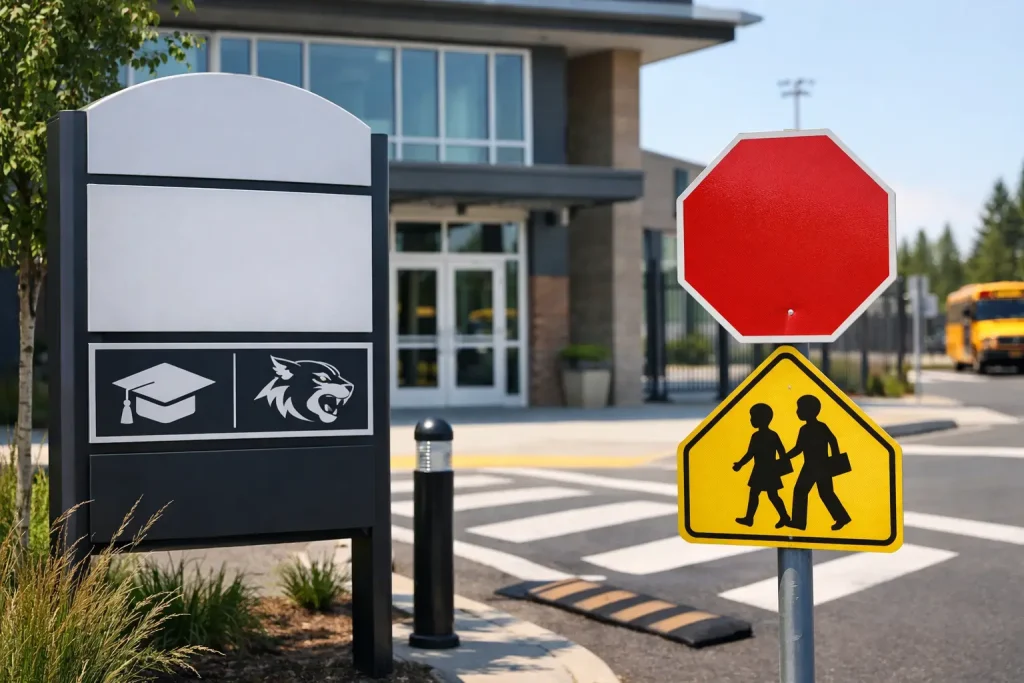
The school gate at 8.30am is where many site problems become visible at once. Cars stop where they should not, visitors are unsure which entrance to use, and important safeguarding messages compete for attention. Custom school signs give schools a practical way to make expectations clear before an issue becomes a daily frustration or a safety risk.
For a primary school, nursery, academy or college, the right sign is not simply a printed message. It needs to suit the audience, withstand the location and support the way the site actually operates. A bright, child-friendly reminder may work well near a reception entrance, while a firm parking control sign is better placed at the perimeter or drop-off area. Good signage helps pupils, families, staff and contractors know where to go and what is expected of them.
Start with the problems on your site
The most effective custom signage starts with a walk around the premises. Look at the route a new parent, visitor or delivery driver takes from the road to reception. Notice where people hesitate, turn around or ignore existing instructions. These are usually the places where a clearer message, better positioning or a more durable sign is needed.
School sites commonly need support in several connected areas: traffic management, visitor direction, safeguarding, health and safety, internal wayfinding and school identity. Treating each sign as an isolated purchase can lead to a cluttered site with mixed messages. A coordinated plan makes the environment easier to understand and gives the school a more professional appearance.
It also helps to separate urgent issues from improvements that can be phased in. Unsafe parking outside the gate or an unclear visitor entrance should come first. Updating older branded boards, creating display areas and adding wall graphics may follow as budget allows.
Use custom school signs where clarity matters most
School gates, parking and traffic flow
Arrival and collection times put pressure on even well-managed sites. Signs can reinforce a school’s parking arrangements, discourage stopping on zig-zag markings and remind drivers to keep entrances clear. Messages such as ‘Protect our children, turn off your engine’ are direct, relevant and easy to understand in a busy moment.
Customisation allows the wording to reflect your own arrangements. A sign can identify staff-only parking, a designated disabled bay, delivery access or a specific one-way route. Where parents need to use an alternative entrance at certain times, the message should state this clearly rather than relying on a generic instruction.
Position is as important as wording. Drivers need to see a restriction before they reach the place where a decision is made. A small sign hidden behind parked vehicles will not solve a parking problem, however well designed it is. Consider pavement buddies for temporary or high-visibility reminders, and fixed signs for permanent controls.
Reception, visitors and safeguarding
A visitor should not have to guess where to report. Clear reception signs, directional arrows and visitor notices make arrival calmer while supporting safeguarding procedures. The message can confirm that all visitors must sign in, wear identification and remain with a member of staff where required.
Schools also need to communicate sensitively. Safeguarding signs should be clear without making the entrance feel unwelcoming. A well-designed board can include the school name, reception direction and visitor expectations in one consistent layout. This is particularly useful on larger campuses where the main office is not immediately visible from the gate.
For nurseries and children’s centres, visual cues can be especially helpful. Friendly colours, simple symbols and easily read type support families who are arriving with young children, pushchairs or siblings in tow. The tone should remain professional, but it does not need to feel severe.
Internal wayfinding and everyday routines
Once people are inside, signs should reduce interruptions for office and teaching staff. Clear directions to classrooms, halls, toilets, offices, medical rooms and assembly points help visitors move confidently through the building. They also support supply staff, contractors and families attending events.
Internal signs are most useful when names and terminology match the words people use every day. If staff refer to an area as ‘The Willow Room’, use that name on the sign rather than an unfamiliar room number alone. On a larger secondary school or college site, colour-coded zones can make routes easier to follow, provided the colours are used consistently across the building.
Temporary needs matter too. Exam signage, wet-play arrangements, open evening directions and event notices should be easy to put in place and remove when no longer required. Pavement signs, banners and display materials offer flexibility without replacing the permanent signs that guide people around the site every day.
Design for the reader, the setting and the weather
A custom sign can carry your logo, school colours, values and contact details, but branding should never obscure the instruction. The most important words need to be readable at the distance and speed at which people will see them. A driver passing the entrance needs a concise message in large type. Someone standing at reception can read more detail.
Contrast is essential. Dark text on a pale background, or pale text on a dark background, is generally easier to read than a design built from several similar colours. Avoid squeezing too much information into one panel. If a sign is trying to direct visitors, explain parking rules, advertise an event and show the school motto, it will probably do none of those jobs well.
Material choice depends on the location. External signs need to cope with rain, sunlight, wind and regular cleaning. Signs near sports areas, playgrounds or vehicle routes may need stronger fixing and more impact-resistant materials. Internal signs may allow more scope for wall graphics, printed panels and changeable displays.
There is a trade-off between permanent and temporary signage. Permanent signs provide consistency and durability, but they need careful wording because changing them later carries a cost. Temporary products are useful for changing instructions, but they should not become a substitute for resolving a recurring issue properly.
Keep the message consistent across the whole school
A school can have excellent individual signs and still create confusion if messages conflict. For example, parents may be told to report to reception on one board but see a separate entrance sign suggesting another route. Review existing signs before commissioning new ones and remove faded, duplicated or out-of-date notices where possible.
Consistency is particularly valuable for multi-academy trusts and education authorities. A shared family of signs can maintain recognisable branding while allowing each school to include its own entrance names, parking rules and site-specific details. This gives visitors a familiar experience without forcing different premises into an identical layout.
A simple approval process is worthwhile. Involve the site manager, school business manager and safeguarding lead where the sign relates to their responsibilities. Teaching staff can also highlight practical issues, such as pupils taking the wrong corridor or parents gathering at an unsuitable gate. Their input can prevent a sign from being accurate on paper but ineffective in practice.
Plan for ordering, installation and maintenance
Before finalising artwork, confirm the wording, dimensions, mounting location and fixing method. Take photographs and measurements of the proposed position, particularly where a sign will be fixed to fencing, brickwork, gates or posts. This helps ensure the finished product suits the site and can be installed safely.
Think ahead about who will maintain the sign. External boards should be checked for damage, loose fixings and fading as part of routine premises inspections. Temporary signs should be collected after an event, rather than left in place until they become background noise. If an instruction changes, replace or remove the old notice promptly. Out-of-date signage can undermine trust in the messages that genuinely matter.
For schools purchasing through formal processes, a specialist supplier that understands purchase orders, site requirements and education-focused products can make ordering more straightforward. Signs 2 Schools can help translate a practical site issue into signage that is clear, durable and appropriate for an education environment.
The best custom school signs do not demand attention for their own sake. They quietly make the school day safer, calmer and easier to manage – from the first car at the gate to the final visitor leaving reception.